UX Internship
1-year UX Internship with GovTech Singapore
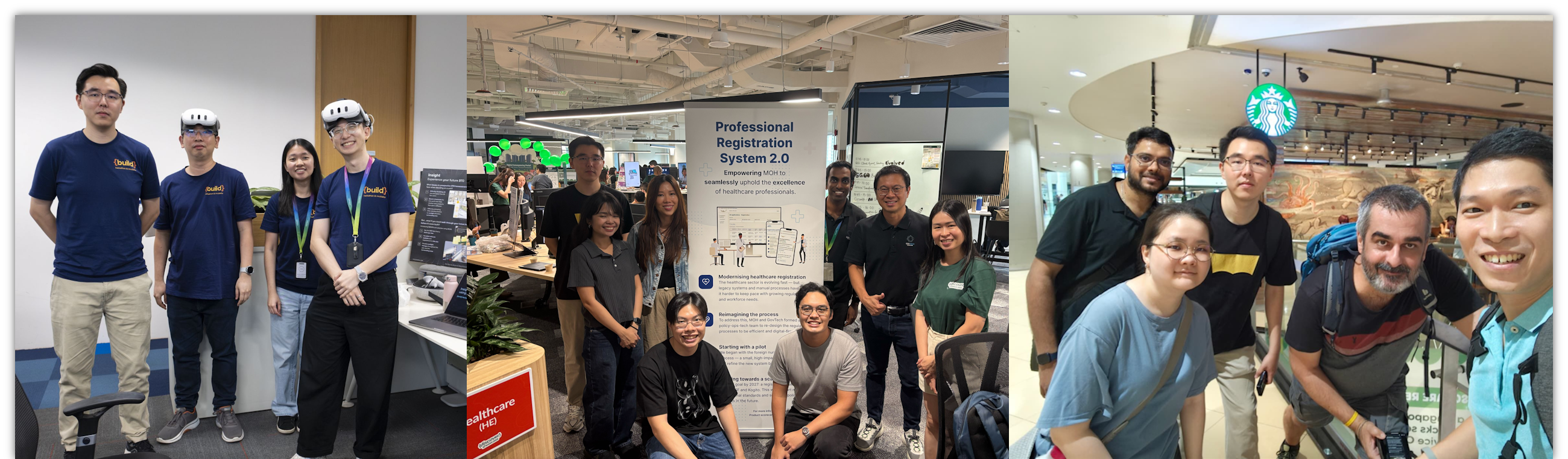
Background
I joined GovTech's Healthcare Tech division as a UX intern on the Professional Registration System (PRS) team, working on the Nursing Registration System (NRS) in collaboration with the Secretariat of Healthcare Professional Boards (SPB).
My Role
UX Designer
Duration
2025 - 2026
Scope
- UX design of 2 standalone modules
- Conduct usability testing
- Note taking and synthesis
Problem
The legacy system could no longer meet growing operational demands, creating unnecessary administrative burden. The NRS portal was built to address this, and also serves as a pilot for consolidating multiple professional boards into a single shared platform under PRS.
Why This Matters
NRS also serves as a pilot to evaluate whether multiple professional boards can be consolidated into a single shared platform, PRS. Given the urgency of the nursing shortage, nursing registration was a strong use case to validate the approach and was prioritised for development. Today, some officers support more than one board and must log into different systems to perform the same workflows. By consolidating and streamlining these processes into one shared system, PRS aims to improve efficiency, simplify legacy workflows, and speed up administrative work.
Team’s Approach
Rather than replacing the legacy system all at once, the PRS team adopted a strategic and incremental approach. Modules within the portal were rebuilt gradually based on feasibility, while the new platform continued to work alongside the legacy system for areas that were not yet ready to be replaced.
This approach allowed the team to roll out improvements in phases, reduce implementation risk, and measure the impact of each module more clearly. It also made it easier to isolate workflow and usability changes as new designs were introduced.
Responsibilities
As a UX intern, I was given the opportunity to lead the UX work on two standalone modules within the portal, as well as contribute to the research phase of a third through note-taking and synthesis. For UX design, my process generally involved mapping user flows, creating lo-fi wireframes, presenting proposals to the team, refining them into hi-fi designs, and running usability tests with end users using Figma prototypes. I then consolidated feedback and iterated on the designs to improve clarity and usability before finally handing it over to the engineers for development.
Learnings
This internship gave me far more hands-on exposure than I anticipated. Across three modules, I had the opportunity to lead UX work end-to-end, from mapping user flows and designing interfaces to running usability tests and presenting to stakeholders, as well as contributing to research through note-taking and synthesis. I am especially grateful to my manager for entrusting me with this level of responsibility as an intern.
Looking back across all three pieces of work, a few themes stood out. Stakeholder alignment was central to every major design decision, whether it was navigating the linear versus free-flow debate in OCR, determining how strictly to enforce deadlines in IPA, or synthesising conflicting pain points across user groups in the CPE research. Good design rarely came from a single perspective.
I also learned that the details matter as much as the structure. Copywriting, traceability, and the tone of a status message all proved to have real consequences on how users understood and acted on information. These were not finishing touches but core parts of the design.
Finally, working on systems with real operational complexity taught me to treat technical constraints and business logic not as obstacles but as inputs to the design process. The best outcomes came from understanding these constraints early and designing within them, rather than around them.